

Sent off in October 2020, the MIT and Accenture Combination Industry and Innovation drive underscores ways industry and innovation can team up to prod development. The five-year drive plans to accomplish its main goal through examination, training, and associations. With that in mind, Accenture has again granted five yearly cooperations to MIT graduate understudies chipping away at research in industry and innovation combination who are underrepresented, including by race, identity, and orientation.
The current year's Accenture Colleagues work in research regions including remote observing, human-PC associations, tasks research, Man-made consciousness intervened socialization, and compound changes. Their exploration covers an expansive scope of tasks, including planning low-power handling gadgets for telehealth applications; applying AI to smooth out and further develop business processes; further developing psychological well-being care through man-made consciousness; and utilizing AI to comprehend the natural and wellbeing results of mind boggling compound responses.
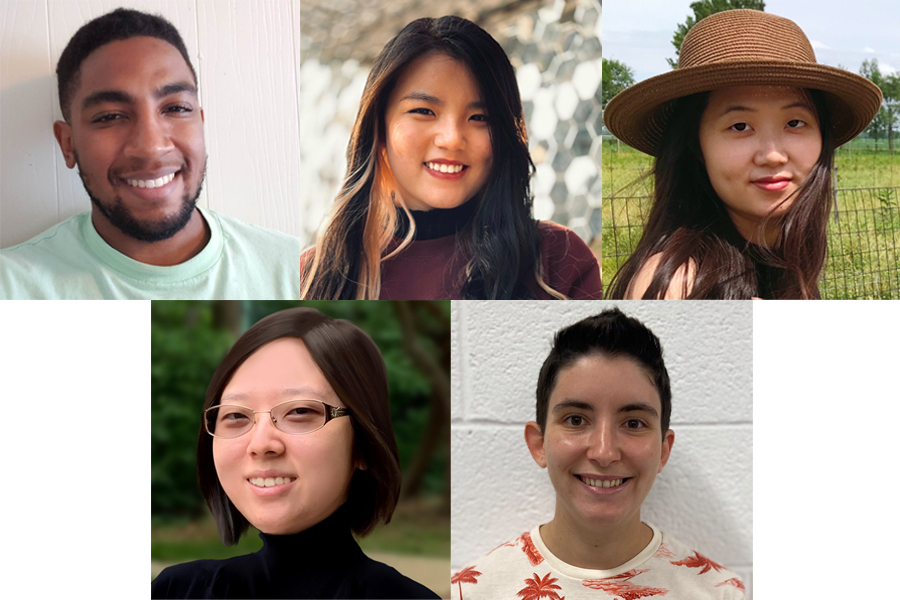
As a component of the application interaction, understudy selections are welcomed from every unit inside the School of Designing, as well as from the four different schools partnered with the foundation and the MIT Schwarzman School of Processing. Five uncommon understudies have been chosen as colleagues for the drive's third year.
Drew Buzzell is a PhD competitor in Electrical Designing and Software engineering whose examination is connected with remote observing, a quickly developing field of telehealth in which data is gathered through Web of Things (IoT)- associated gadgets and sent to the cloud. Right now, the enormous volume of data associated with remote checking — and the significant investment expenses of handling it — make information investigation troublesome. Buzzell's work centers around edge processing, another registering engineering that looks to address these difficulties by overseeing information near the source, in a dispersed organization of IoT gadgets. Buzzell has a BA in Physical science and Designing Sciences and a Bosses in Designing Sciences from Penn State College.
Mingying (Kathy) Fang is a master’s student in the MIT School of Architecture and Planning. Her research focuses on augmented reality and virtual reality platforms. Fang develops new sensors and machine components that combine computation, materials science, and engineering. Going forward, you will explore topics including soft robotics technologies that can be combined with clothing and wearable devices and haptic feedback in order to develop interactions with digital objects. Fang holds a bachelor’s degree in mechanical engineering and human-computer interaction from Carnegie Mellon University.
Xiaoyue Gong is a doctoral candidate in Operations Research at the MIT Sloan School of Management. Her research aims to harness the power of machine learning and data science to reduce operating inefficiencies in businesses, organizations, and society. Supported by an Accenture Fellowship, Gong pursues solutions to operational problems by designing reinforcement learning methods and other machine learning techniques for embedded operational problems. Gong has a BA in Mathematics with Honors and Interactive Media Arts from New York University.
Ruby Liu is a doctoral student in the Medical Engineering and Medical Physics program, which is part of the Harvard-MIT Program in Health Science and Technology. Their research addresses the pervasive pandemic of loneliness among older adults, which leads to poor health outcomes and poses particularly high risks for historically marginalized people, including members of the LGBTQ+ community and people of color. Liu designs a network of interconnected AI agents that enhance user-agent connections, delivering mental health care while strengthening and facilitating human-to-human connections. Liu holds a Bachelor’s degree in Biomedical Engineering from Johns Hopkins University.
Jules Provenzano is a PhD candidate in Chemical Engineering. Their work integrates machine learning and liquid chromatography high-resolution mass spectrometry (LC-HRMS) to improve our understanding of complex chemical reactions in the environment. As an Accenture Fellow, Provenzano will draw on recent advances in machine learning and LC-HRMS, including new algorithms for processing real and experimental HR-MS data and novel approaches to extracting structural and kinetic transformation rules. Their research can accelerate the pace of discovery in the chemical sciences and benefit industries including oil and gas, pharmaceuticals, and agriculture. Provenzano holds a BA in Chemical Engineering and International and Global Studies from Rochester Institute of Technology.